
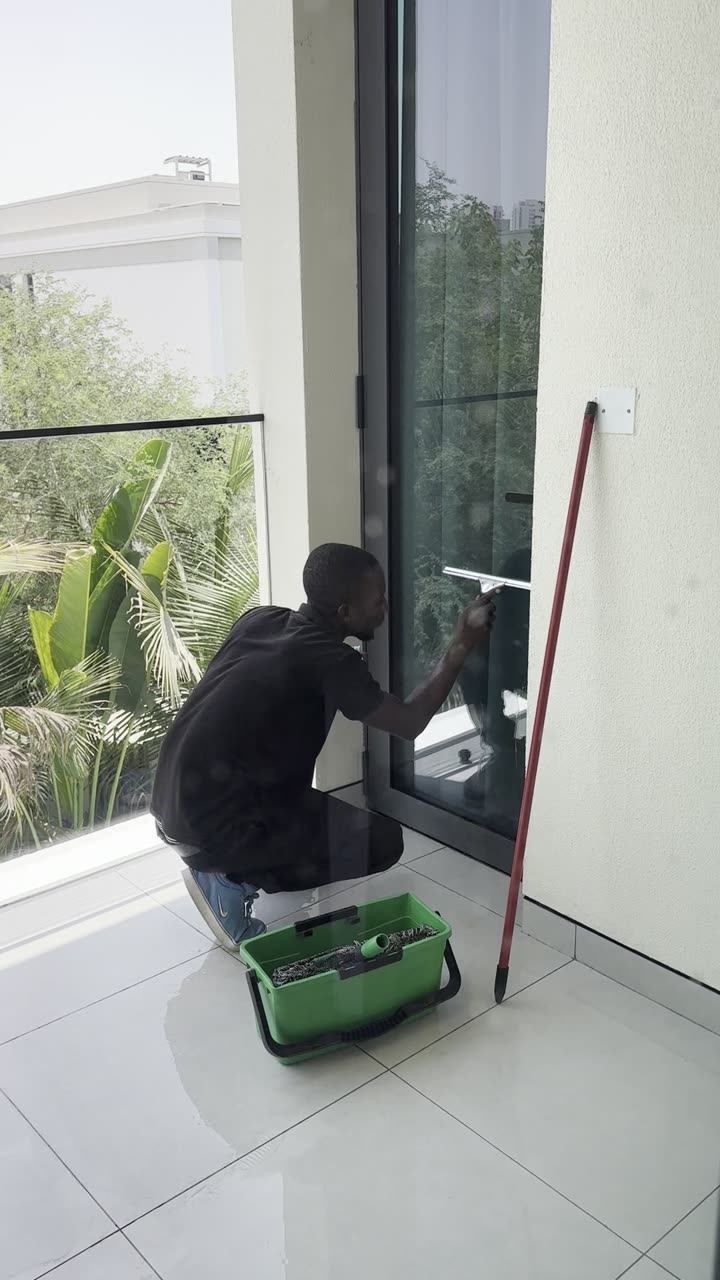
You clean the shower screen on Saturday and by Wednesday it has a white veil again. The chrome tap has a chalky ring at the base, the rain shower sprays sideways, and the glass balustrade on the balcony is covered in dull spots. Most of this is limescale, and most of it comes off. The real risk is the product you reach for: the acids that dissolve limescale also attack marble, grout and many modern tap finishes. This guide explains how to tell what you are looking at, what is safe on which surface, and where cleaning ends.
What are hard water marks, and why do they build up so fast?
Hard water marks are the minerals left behind when water evaporates. Tap water carries dissolved calcium and magnesium. The water dries, the minerals stay, and each shower adds another thin layer to the last one.
Three things speed this up in a Dubai home. Bathrooms are warm, so droplets dry quickly where they hang instead of running off. Glass shower screens and frameless enclosures give water a large, flat surface to dry on. And household dust here is largely mineral: a 2023 study of twenty Dubai homes found calcium as the largest element in indoor dust, at an average of 14,170 mg/kg.1 Dust that settles on wet glass becomes part of the film.
You will often read a precise hardness figure for Dubai tap water. We do not give one. The published numbers contradict each other, and we have not seen a current official water quality report that settles the question. If you want to know your own water, hardness test strips cost little and take a minute. For cleaning, the answer is the same either way: water that is wiped off cannot leave anything behind.
Is it limescale, soap scum or etching?
Look before you clean. White chalky deposits, greasy grey films and permanent etching need three different treatments, and one of them does not respond to cleaning at all.
The simplest test is water. Wet the cloudy area with clean water and look again. A deposit sitting on the surface usually fades while the glass is wet and reappears as it dries. Etching, where the surface of the glass itself has been roughened, still looks hazy when wet.
| What you see | Likely cause | What helps |
|---|---|---|
| White, chalky spots or rings that feel slightly rough | Limescale | Mild acid descaler or steam, then rinse and dry |
| Grey, greasy film that smears | Soap scum, often mixed with limescale | Remove the grease first with a mild detergent, then descale |
| White crust at the base of taps and around the drain | Thick limescale | Repeated short applications, never a blade on chrome |
| Haze that stays when the glass is wet, rough to the fingertip | Etched glass | Cannot be cleaned off; ask a glass specialist |
| Dull spots on outdoor glass and balustrades | Dust and dried water from irrigation, rain or condensation | Rinse the dust off first, then clean; dry wiping scratches |
| Rainbow sheen or patchy marks on coated glass | Damaged coating | Stop using acid or abrasives, check the supplier’s care sheet |
Which products are safe on which bathroom surfaces?
Acid dissolves limescale, but it does not know the difference between limescale and your vanity top. Check every surface the product touches, including the ones it drips onto.
| Surface | Safe approach | Avoid |
|---|---|---|
| Clear shower glass | Mild acid descaler or diluted vinegar, short contact time, rinse, squeegee | Scouring powder, steel wool, razor blades used flat at the wrong angle |
| Coated “easy clean” glass | Mild detergent, soft cloth, whatever the supplier’s care sheet allows | Abrasive pads, strong descalers unless the supplier approves them |
| Polished chrome taps | Descaler on a cloth, not sprayed; rinse and dry | Scouring pads, bleach left to sit |
| Brushed, matt black, gold or coloured fittings | Mild detergent and a soft cloth, manufacturer’s instructions | Acid descalers and vinegar unless the manufacturer allows them |
| Glazed ceramic and porcelain tiles | Descaler is usually fine on the glaze | Letting it run into cement grout |
| Cement grout | pH neutral cleaner, a soft brush, steam | Acids, which attack the cement |
| Marble, travertine, limestone | pH neutral stone cleaner, dry immediately | Vinegar, lemon, any descaler, even a drip |
| Enamel bath and acrylic shower tray | Mild descaler, soft cloth | Abrasive powders, which dull the surface |
| Mirrors | Glass cleaner on the cloth, not sprayed at the edges | Liquid running into the edges, where the backing sits |
When you buy a descaler, read the label for the surfaces it is meant for and the contact time. Household detergents sold in the UAE fall under a national conformity scheme, Cabinet Resolution No. 96 of 2024, which among other things requires allergenic fragrances above 0.01 percent to be declared.2 That will not tell you whether a product suits your stone, but it does mean the label should tell you what is in the bottle.
Never mix descalers with bleach or other cleaners. Use one product, rinse it off completely, then use the next.
Why must acid never touch marble or grout?
Because marble is chemically a close relative of limescale. Limescale is mainly calcium carbonate. Marble, travertine and limestone are made of calcium carbonate too. A descaler that dissolves the white crust on your tap dissolves the polished surface of your stone in exactly the same way.
The result is etching: a dull, slightly rough patch where the polish used to be, often in the shape of the drip that caused it. It does not wipe off, because there is nothing on the surface to wipe. Restoring it means honing and polishing the stone, which is work for a stone restoration specialist, not for a cleaner.
The usual cause is not someone cleaning the marble with vinegar. It is a descaler sprayed onto the shower glass that runs down onto a marble floor, or a tap descaled over a stone vanity. Protect the stone with a towel, apply the product to a cloth rather than spraying it, and rinse anything that drips straight away.
Cement grout is the second casualty. Acids attack the cement between tiles, washing it out a little more each time. Grout that looks sandy or recessed in a shower is often the result of years of strong descalers.
How do you remove limescale from shower glass, step by step?
Work from the top down, keep contact times short, and finish dry.
- Protect what sits below. Lay a towel over a stone floor or vanity, and check what the tray and the grout are made of.
- Rinse first. Warm water removes loose dust and soap, so the descaler works on the limescale rather than on dirt.
- Degrease if there is soap scum. A mild detergent on a soft sponge, rinsed off. Descaler does little through a layer of soap.
- Apply the descaler to a cloth or sponge. Spread it evenly over the glass, never sprayed into the air near stone or metal fittings.
- Give it a short time to work. Follow the label. Longer is not better on fittings and seals.
- Wipe with a non scratch pad. Use the soft white type, not the green kind, and work in straight lines.
- Rinse thoroughly. Leftover descaler on glass dries into its own film.
- Squeegee, then dry the edges and fittings with a microfibre cloth.
For thick deposits, two or three short rounds work better and safer than one long soak. If the glass still looks cloudy when it is wet after that, you have reached etching, and more product will not change it.
What about taps, shower heads and rain showers?
Treat the fitting by its finish, and treat the nozzles separately. Polished chrome tolerates a descaler on a cloth, rinsed and dried. Brushed, matt, coloured and gold finishes are often coatings, and many manufacturers rule out acids and vinegar on them. Check the care instructions before you test anything on a fitting that cost more than the rest of the bathroom.
Rain showers and hand showers usually have soft rubber nozzles. Rubbing them with a fingertip while the water runs breaks off much of the scale inside. If the head comes off easily, soak only the nozzle plate, not a coated body, in a suitable descaler, then rinse it well. Aerators on basin taps unscrew and can be soaked the same way. Our guide to kitchen deep cleaning covers kitchen taps, steel sinks and stone worktops in more detail.
Can steam remove limescale without chemicals?
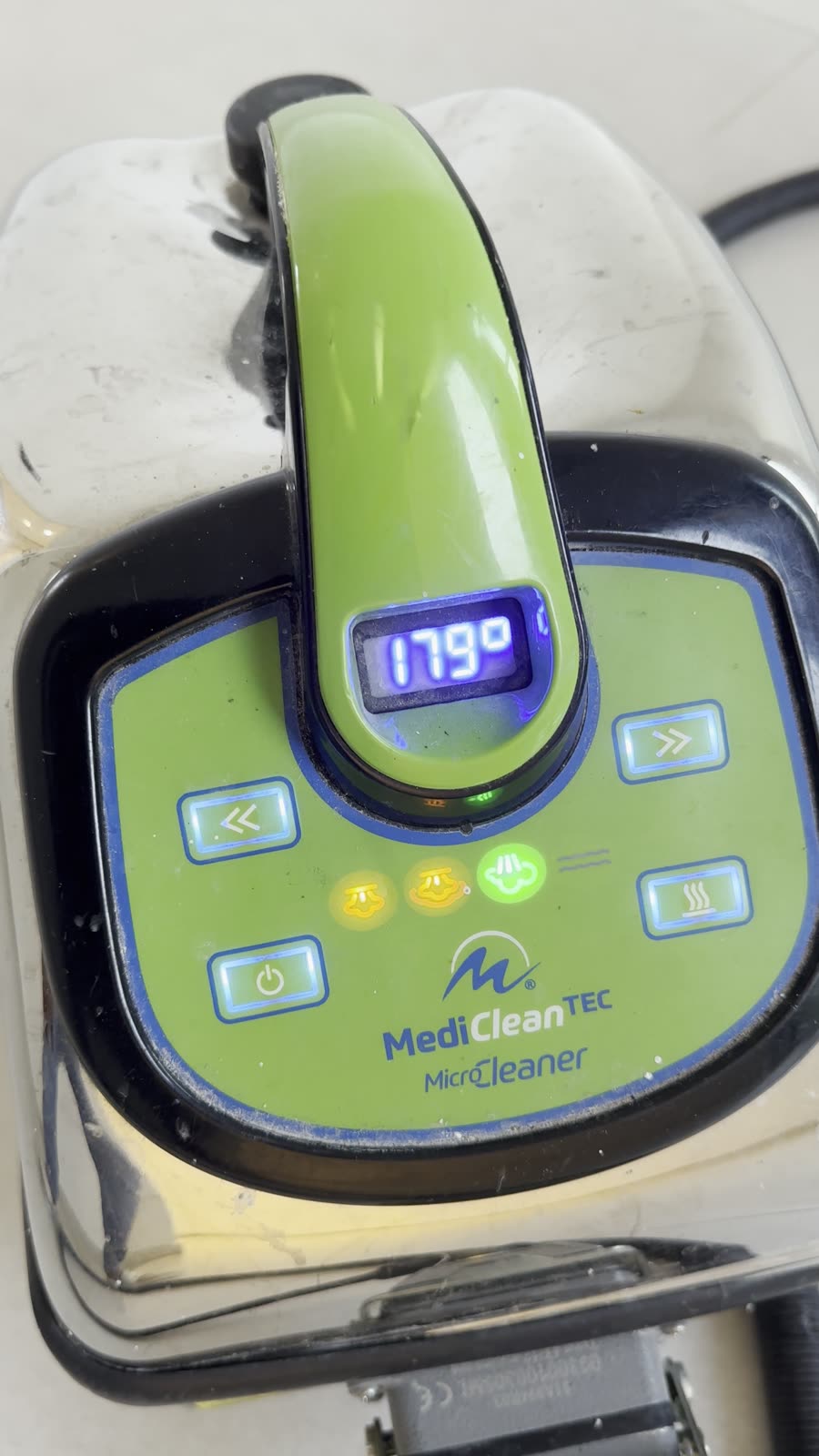
Often, on heat tolerant surfaces. Dry steam softens limescale on glass screens, chrome, ceramic tiles and shower trays, so a cloth can lift it with little or no descaler. Our steam machine reaches 179 °C at the display on a job in Dubai, which is our own reading rather than a laboratory figure.3
Steam has limits. It loosens, it does not remove: every pass has to be followed by a cloth and a dry finish, or the dissolved minerals dry back onto the glass. Thick, old crusts usually need steam and a suitable descaler together. We keep the jet moving on glass, away from mirror edges and away from silicone joints that are already lifting. Steam on grout is useful because it cleans the joints without acid. For where steam fits and where it does damage, see what steam cleaning at 180 °C can and cannot do.
How do you stop limescale from coming back?
Remove the water before it dries. Every prevention method is a version of that one rule.
- Squeegee the shower glass after every shower. It takes less than a minute and removes most of the water that would otherwise dry into a film.
- Wipe taps and the basin rim dry after use, especially the base of the tap where water collects.
- Run the bathroom extractor during and after showering, and leave the door open afterwards, so the room dries out.
- Clean little and often. A light weekly wipe with a mild product does far less harm than a monthly attack with a strong one.
- Look at outdoor glass after irrigation. Sprinklers that reach balustrades and windows leave spots in the sun every day. Adjusting a sprinkler head is easier than cleaning glass.
- Be careful with promises on shower filters and softeners. If a product claims to reduce hardness, ask the seller for test data on hardness specifically, not on other substances in the water.
When does it need a professional, and when can no cleaning help?
A professional deep clean makes sense when limescale is thick and old, when several surfaces need different products in the same room, or before a handover, when every screen, tap and drain has to look right on the day. Shower glass and fittings are part of every home deep clean in Dubai, and our guide to what a home deep clean includes lists the rest. Windows, frames and glass balustrades that can be reached safely are covered by our window cleaning in Dubai.
Some damage is beyond any cleaner, and you should hear that before anyone starts:
- Etched glass stays cloudy when wet. It can sometimes be improved by a glass specialist, but not by cleaning.
- Etched marble or travertine needs honing and polishing by a stone restoration specialist.
- Damaged coatings on glass or fittings do not come back with any product.
- Washed out grout needs regrouting.
We test in a hidden spot, tell you on the day what we expect to come off and what will not, and agree one fixed price on WhatsApp before we start, with no extra charges on the day.