
Search for dust mites from the UAE and you will find a lot of alarming close up photos and a lot of products. What you will rarely find is what research from this country actually says. It turns out to be more reassuring, more nuanced and more useful than the marketing, and it points to two things you can control at home: the humidity in your bedroom and how regularly dust leaves the house.
One note before we start. This is a guide about cleaning and indoor climate, not about medicine. If you have symptoms, a doctor or allergist is the right first stop, and nothing here replaces a test.
Are dust mites really the main problem in UAE homes?
Probably not, based on the local evidence. The only UAE skin prick study we could find, carried out at Tawam Hospital in Al Ain with 327 patients tested between 1996 and 1998, found a positive reaction to house dust mite in about 9.5 percent of patients and to house dust in 11.9 percent1. Pollen came out well ahead: poplar at 33.1 percent and Bermuda grass at 31.3 percent1. The study is old and small, so treat it as an indication rather than a verdict.
A larger survey of adults across the UAE points the same way and adds something important. Allergic rhinitis was found in 7 percent of respondents, and their symptoms were most often aggravated by dust (59 percent), followed by grass and pollen (44 percent) and proximity to animals (21 percent)2. The authors conclude that “measures to control allergens and dust are needed”2. Dust in general, not mites specifically.
Children are a different picture, and the numbers are higher. A survey of 3,436 schoolchildren in Dubai and the Northern Emirates in 2019 found asthma in 11.9 percent of children aged 6 to 7 and 9.8 percent of those aged 13 to 14, and allergic rhinitis in 46.5 and 51.3 percent3. The authors write that “perennial indoor allergens, seasonal pollens, and molds are the most common allergens that cause allergic rhinitis”3. The study does not name dust mites, humidity or air conditioning as causes, and it was funded by a pharmaceutical company, which the authors disclose.
| Study | Who was studied | What it found | What it does not show |
|---|---|---|---|
| Tawam Hospital, Al Ain | 327 patients, skin prick tests, 1996 to 1998 | Mite 9.5 %, house dust 11.9 %, poplar 33.1 %, Bermuda grass 31.3 %1 | Current levels; small, old sample |
| Mahboub et al., 2014 | Adults across the UAE | Rhinitis 7 %; symptoms aggravated by dust 59 %, pollen 44 %, animals 21 %2 | Which part of dust is the trigger |
| Ibrahim et al., 2021 | 3,436 children, Dubai and Northern Emirates | Asthma 11.9 % and 9.8 %, rhinitis 46.5 % and 51.3 %3 | Any link to mites, humidity or AC |
The honest summary: dust is a well documented trigger in the UAE, mites are one possible part of it, and pollen is at least as relevant. That is why the rest of this guide is about controlling dust and humidity in general rather than fighting one creature.
Why is humidity the lever that matters most?
Because it is the one factor in your home that is linked to mites by a local authority and that you can measure and change yourself. Dubai Municipality makes the link explicitly. Its indoor air quality guideline says to “keep relative humidity below 60% (50%, if feasible, to control dust mites)”4. It is one of the few places where a UAE authority mentions mites at all.
The desert outside does not mean dry air inside. From July to September, the outdoor dew point in Dubai sits at or above 24 °C in more than half of all hours5, which means the air carries a lot of water. How much of it ends up in your bedroom depends on the air conditioning. An AC that runs with the fan on continuous, a blocked condensate drain or a coil clogged with dust all leave the room cool but damp.
So the first practical step costs very little: put a digital hygrometer in the bedroom. If it reads above 60 percent with the AC running, our guide on why an apartment stays humid even with the AC on walks through the causes and which of them you can fix yourself.
Does heat or hot washing get rid of dust mites?
Heat affects mites, but removal matters more, and that finding comes from the same research people quote for heat. A laboratory study on laundry found that water at 55 °C or above left no live mites6. The same study found that a cold wash removed few live mites but cut the main mite allergen, Der p 1, by more than 90 percent6.
Two other laboratory studies looked at steam and heat directly. One found that a hard surface steam cleaner delivering 96 °C steam onto textiles left none of the tested mites alive7. Another found that mite eggs did not survive 60 to 70 °C, and recommended holding that temperature for at least 30 minutes so no larvae hatch8.
What these studies have in common is that they were done under controlled conditions, on thin textiles, with known contact times. In a thick mattress or a sofa cushion nobody measures how deep the heat reaches or for how long. And the allergen stays in the fabric after a mite has died. That is why we treat steam as one step between two thorough vacuum passes, and why we never describe the result as mite free.
Why does removing dust matter more than heat?
Because whatever is removed is gone, whether it is mite material, skin flakes, pollen or desert dust, and that is the category the UAE survey identified as the most common trigger2. Dust in Dubai homes is also largely mineral. A 2023 study of indoor dust from Dubai homes measured calcium at an average of 14,170 mg/kg, alongside potassium, magnesium, aluminium and iron9. Fine mineral dust settles into textiles and gives them a grey, flat look long before they look dirty.
In practice that means:
- Vacuum slowly. Fast strokes move dust around, slow ones lift it.
- Use a vacuum that keeps fine dust in. A full bag or a clogged filter loses suction and lets fine particles escape.
- Damp dust hard surfaces instead of dry wiping. Dry wiping mineral dust both spreads it and scratches.
- Wash what can be washed, regularly, rather than occasionally at a very high temperature.
What routine actually makes sense in a UAE home?
A steady routine beats an occasional big effort. The intervals below are our suggestion for a typical air conditioned apartment, except where a source is named. Adjust them for pets, small children or windows that are often open.
| How often | What to do | Why |
|---|---|---|
| Daily, in summer | Glance at the hygrometer in the bedroom | Target below 60 %, ideally below 50 %4 |
| Weekly | Wash sheets and pillowcases; hot only where the label allows | Washing removes allergen even when cold6 |
| Weekly | Vacuum the bedroom floor, rugs and the mattress surface slowly | Removal over heat |
| Weekly | Damp dust bedside tables, headboard, window sills | Mineral dust, not lint9 |
| Monthly | Wash pillow and mattress protectors and throws; check the AC tray and drain | Dubai Municipality asks for trays to be cleaned at least monthly4 |
| Monthly | Vacuum sofa cushions on all sides, and under the bed | Dust collects where nobody looks |
| Every six months | AC coil and condensate pipes cleaned | Dubai Municipality minimum interval4 |
| Every six months | Mattress vacuumed and steamed on both sides; turn or rotate it | Dust collects deep in the mattress |
| Yearly | Curtains, carpets and sofas cleaned properly | Large textiles hold dust for months |
Two habits are worth adding. Make the bed later in the morning, after the room has aired, rather than straight away. And keep soft toys, extra cushions and throws in the bedroom to the ones you actually use, because every one of them is another surface to keep clean.
What can a professional clean do, and what can it not?
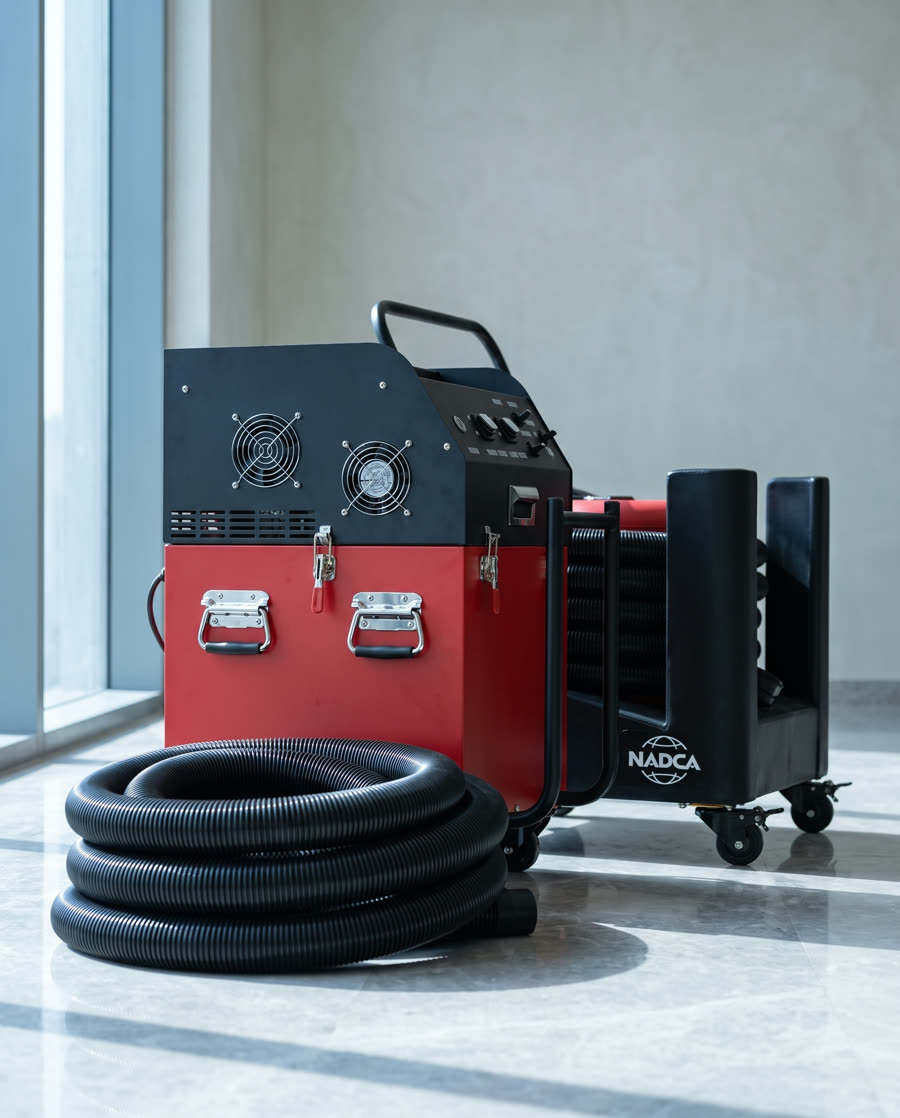
A professional clean removes what a household vacuum leaves behind, especially from mattresses, sofas and carpets. Our mattress cleaning in Dubai works dry: a slow pass with a water filtration vacuum, steam on the surface and seams, and a second pass to take away what the steam has loosened. The same logic applies to sofa cleaning and to carpet cleaning, with the method adjusted to the fabric.
What it cannot do is make a home mite free, treat an allergy or replace medical advice, and any provider that promises those things is guessing. A clean is a reset. The humidity and the weekly routine above are what keep the result.
When should you see a doctor rather than a cleaner?
When you have symptoms that do not go away, wake up congested, or have a child with wheezing or a persistent cough. Only an allergy test can show whether dust mites, pollen, mould, animals or something else is the trigger, and the UAE studies above show how much these differ from person to person.
Cleaning and humidity control are sensible either way, and they help the whole household. If the main problem in your home is a damp or musty smell rather than dust, our guide to the most common sources of a musty smell is the better place to start.