
You have lived in your apartment for a year and never seen the thing that cools it. There are slotted grilles in the ceiling, a thermostat on the wall, perhaps a square access panel in the corridor or the bathroom ceiling, and no outdoor unit anywhere on your balcony. Then in December the air starts to smell of a damp cellar when the cooling comes on, and nobody seems able to say whose problem that is. In most Dubai towers, the answer sits behind that access panel: a fan coil unit. This guide explains what it is, how it differs from the other systems, who is usually responsible for which part, and what a proper clean of it involves.
What is a fan coil unit?
A fan coil unit, often shortened to FCU, is a box that contains a fan and a cooling coil, fed with chilled water from the building. It is the indoor end of a central cooling system, and in an apartment it is typically installed above a false ceiling, out of sight.
Inside the box are a few parts that matter for you:
- Filter: at the air intake, catching dust before it reaches the coil.
- Cooling coil: a block of thin metal fins around tubes that carry chilled water. Warm room air passes through it and gives off heat and moisture.
- Fan or blower: moves room air through the filter and coil and out to the rooms.
- Condensate tray: under the coil, catching the water that condenses on it.
- Drain: a pipe that carries that water away from the tray.
- Valves and actuator: on the chilled water pipes, opening and closing as the thermostat asks for cooling.
- Short ducts or a plenum: carrying cooled air to supply grilles and returning room air through a larger return grille.
What is missing is just as important. A fan coil unit has no compressor and no refrigerant gas in your apartment. The cold is produced elsewhere, in a central chiller plant on the roof or in the basement, or by a district cooling network, and arrives as cold water in insulated pipes.
How is it different from a split or a ducted unit?
All three cool the air with a coil, but they get the cold from different places, and that decides who can work on what.
| Wall split | Ducted split (DX) | Fan coil unit on chilled water | |
|---|---|---|---|
| Where it sits | High on the wall, visible | Above the false ceiling | Above the false ceiling |
| How the coil gets cold | Refrigerant from its own outdoor unit | Refrigerant from its own outdoor unit | Chilled water from the building or a district network |
| Outdoor unit of its own | Yes | Yes | No |
| Refrigerant gas in the flat | Yes | Yes | No |
| Typical home | Older buildings, single rooms, many villas | Villas, townhouses, some apartments | Many apartment towers |
| Parts that need regular cleaning | Filter, coil, tray, drain, blower, outlet | Filter, coil, tray, drain, blower, grilles, sometimes ducts | Filter, coil, tray, drain, blower, grilles, sometimes return path |
| Who handles the cold side | AC contractor | AC contractor | Building maintenance or the cooling provider |
From below, a ducted split and a fan coil unit look almost identical: grilles in the ceiling and an access panel. The quickest way to tell them apart is to look outside. If no outdoor unit belongs to your apartment and the building advertises central or district cooling, you almost certainly have a fan coil unit. Our guide on AC service vs AC cleaning vs duct cleaning explains how each system affects which service you need.
Who is responsible for which part?
The building is normally responsible for the chilled water, and your contract decides the rest. That is the honest summary, and it is worth breaking down because the fan coil sits exactly at the border between your flat and the building.
| Part | Usually handled by | Why |
|---|---|---|
| Central plant, chilled water supply, risers | Building management or the cooling provider | Shared by all units, outside your control |
| Valves, actuators, pipe insulation at the FCU | Building maintenance | Part of the chilled water circuit |
| Thermostat settings and use | Occupant | Fan mode and set point affect moisture in the room |
| Grilles and the filter you can reach | Occupant, often | Everyday care, within reach |
| Coil, condensate tray, drain, blower | As your contract or building rules say | Periodic maintenance, assigned differently in every building |
| Leaks, sweating pipes, wet ceiling boards | Landlord or building | Faults, not cleaning |
On the legal side, Dubai Law No. (5) of 2025 on public health places a continuing obligation on the owner of a building to carry out cleaning and to keep indoor air within acceptable levels1. That does not automatically mean your landlord pays for every FCU clean. It means the conversation starts from an owner duty, and your tenancy contract and the building rules fill in the detail. This is general information, not legal advice. Our guide on who pays for AC cleaning in Dubai goes through the documents that decide it in practice.
Why does a fan coil unit smell worse in December and January?
Because it runs less, and water stands longer. In summer the unit cools for hours, condensate drains steadily and the tray rarely sits still. In the cooler months the thermostat calls for cooling less often, the valves stay closed for longer, and whatever water is left in the tray stands between cycles.
Dubai’s winter air is also wetter than people think. In ten years of hourly ERA5 data for Dubai, outdoor relative humidity is higher in January than in July, even though the dew point is far lower and stays below 24 °C in every hour from December to April2. Damp, mild air, a tray that is not draining fully and a coil that stays wet between short cycles is the combination behind the cellar smell when the cooling starts.
Dubai Municipality’s indoor air guideline lists “microbiological growth in drip pans, humidifiers, ductwork, coils” among sources of indoor air contamination, and advises to “clean drain pans often and ensure a proper slope to keep water draining”3. For a fan coil, that is the whole diagnosis in one sentence. Other sources of a musty smell, such as wardrobes on outside walls or dry drain traps, are covered in our guide to the musty smell in a Dubai apartment.
How often does a fan coil unit need cleaning?
More often at the tray than at the coil. Dubai Municipality’s guideline, which lists residential buildings in its scope, asks for coils and condensate pipes to be cleaned at least every six months and for trays to be cleaned at least every month and based on condition3. It also asks for an inspection of the building and its HVAC system at least every three months, and for records of all maintenance work to be kept3.
The guideline is written with “should”, not “shall”, so it is a standard to work towards rather than a fine waiting to happen. It is still the most specific Dubai reference there is, and it puts the tray and the coil ahead of the ducts. NADCA’s standard, written for the duct cleaning industry, treats the ducts the same way: inspection at set intervals, cleaning only when the condition calls for it4.
In practice, if your building’s maintenance team services the FCUs on a schedule, ask when the tray and coil were last cleaned, and ask to see the record. If nobody does, a clean before winter and one before summer covers the six month coil interval and catches the tray at the two moments it matters most.
What does a proper fan coil clean include?
The parts that hold dust and water, in the right order, with the drain tested before and after. A filter rinse and a spray on the front of the coil is not a fan coil clean.
- Access and protection: the unit is switched off at the thermostat, the access panel is opened, and the floor and furniture underneath are covered.
- Drain tested before cleaning: water poured into the tray shows whether it drains, slowly or not at all.
- Filter: removed, washed or replaced.
- Coil: cleaned on the faces that can be reached, with a cleaner suited to the fins, rinsed and drained through the tray.
- Condensate tray: scrubbed clean of sludge and deposits.
- Drain: flushed and tested again after cleaning. The EPA’s checklist for a finished job asks exactly this: “Is the coil drain pan completely clean and draining properly?”5
- Blower wheel and housing: cleaned where they can be reached.
- Supply and return grilles: taken down and washed. The return side and plenum are inspected for dust.
- Refit and check: filter back in, panel closed, cooling switched on and airflow checked at every grille.
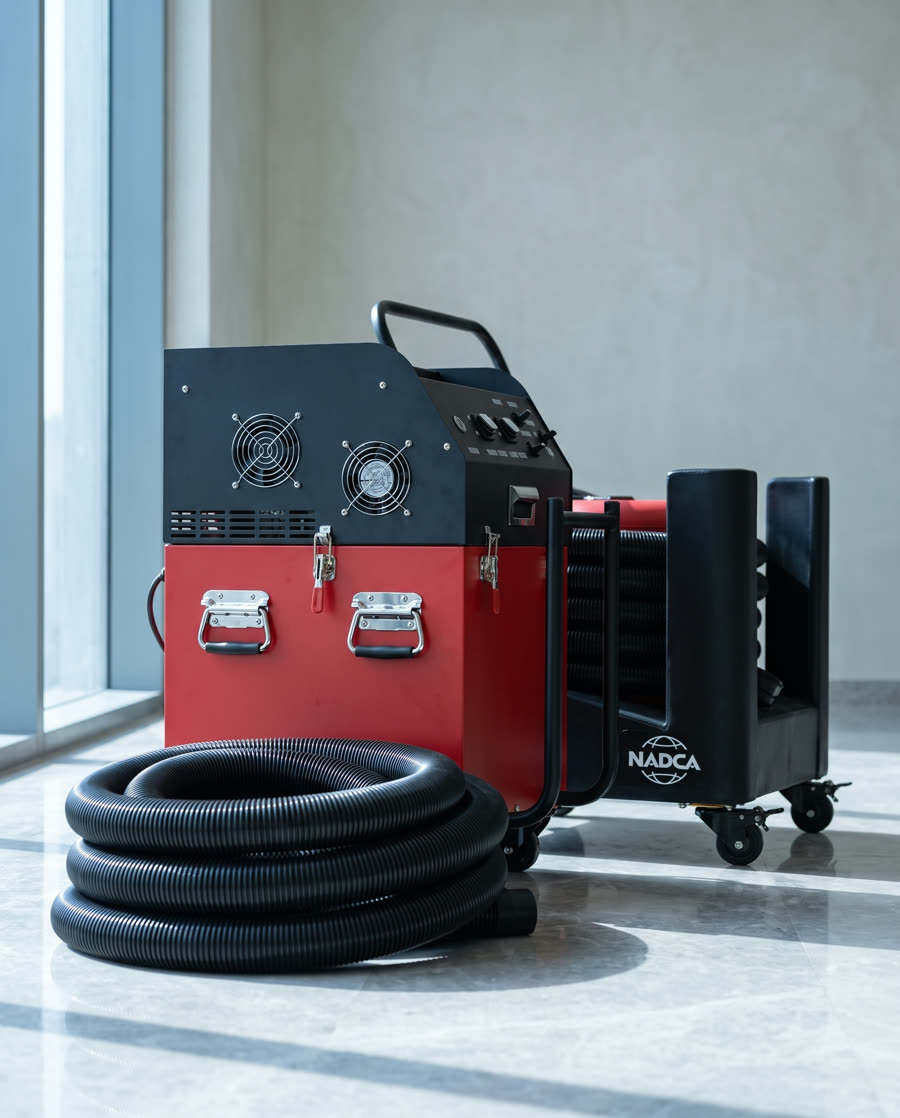
The NADCA standard sets out the same logic for whole systems, including cleaning the condensate pan and testing the drain before and after4. Our AC cleaning in Dubai follows that order with our own technician, and the same applies in Sharjah on our AC cleaning in Sharjah page.
What a clean does not include: chilled water valves, actuators, pipe insulation and anything on the building’s circuit. If our technician finds a cracked tray, a drain that is broken rather than blocked, or sweating pipes above the ceiling, we tell you and the building maintenance team. Repairs are a separate job, agreed with you first, and on a fan coil the chilled water side stays with the building in any case.
What should you prepare before the visit?
Mostly permission and access. Fan coil units sit in shared ceiling space in many towers, so some buildings want to know before a contractor opens a panel.
- Check whether your building requires a work permit or NOC for AC cleaning, and request it a few days ahead.
- Find the access panel: corridor, bathroom or kitchen ceiling are common places.
- Clear the space underneath it, and move anything fragile from below the grilles.
- Send a photo of the access panel, one supply grille and the return grille on WhatsApp, and say how many units your apartment has.
- Note any symptoms: smell on start up, dripping, dust from a grille, rooms that do not cool. They tell the technician where to look first.
With that, we agree a fixed price before we start and plan the visit around your building’s rules, with no extra charges on the day.